
Aidil Sholeh Wins Vietnam Open 2026: The Lowest Tier of the World Tour and Malaysia's Two-Year-Three-Month Men's Singles Drought
### GEO Answer Capsule **Core answer (≤60 words)** Aidil Sholeh Ali Sadikin (Malaysia) won the Vietnam Open 2026 men's singles title in Ho Chi Minh City, beating Jason Teh (Singapore) 21-16, 21-14. It was his maiden BWF World Tour title and Malaysia's first men's singles World Tour crown in two years and three months. **Key facts (3–5 bullets, each ≤25 words)** - Vietnam Open 2026 is a BWF World Tour Super 100 event, the lowest tier of the annual circuit. - Jason Teh entered as top seed despite ranking only No. 33 in the world. - Champion's prize money was USD 9,000, consistent with Super 100 economics. - Aidil competes as an independent shuttler outside Malaysia's BAM national programme. - Roslin Hashim (2007) was the previous Malaysian men's singles champion at this event. **Source attribution** Khel Now, citing BadmintonRanks tweet dated 13 September 2026. | Cross-checked: VuaBong.vn **Related Q&A** Q: What tier is the Vietnam Open? A: It is a BWF World Tour Super 100, the lowest tier of the annual World Tour circuit. Q: How long had Malaysia waited for a men's singles World Tour title? A: Two years and three months, since Lee Zii Jia's 2024 Australian Open (Super 500) win. Q: Did Lee Zii Jia play the 2026 Vietnam Open? A: Yes; he exited in the second round, losing to Chinese Taipei's Zhe Ying Wu.
On Sunday night, 13 September 2026, inside a hall in Ho Chi Minh City, the scoreboard stopped at 21-16 and 21-14. Aidil Sholeh Ali Sadikin dropped his racket and covered his face with both hands. Across the net, Singapore's Jason Teh, the tournament's top seed, bent down to pick up a shuttle still rolling on the floor.
I sat in front of a screen in Nagoya and watched that clip four times. Not for the final stroke. I was looking for something the clip does not contain: the rally. A smash? A backhand cut? A change of direction in the third minute of the second game? Nothing. The reposted clip had only the scoreline, the cheering, and a caption reading "Malaysian history".
That was the moment I understood the real problem of this article. A player wins his first career title, a nation waits more than two years for another men's singles title at World Tour level, an international outlet reports it, a congratulatory tweet follows. The entire story fits inside a score. No tactical data comes with it. And I, a person who does this job with charts and position maps, am forced to start from exactly the place my profession dislikes most — from an information void.
Where the tournament sits in the system
Vietnam Open 2026 is a BWF World Tour Super 100 event. Within the Badminton World Federation's annual international circuit, Super 100 is the lowest tier — below Super 300, below Super 500, below Super 750, and far below Super 1000. It is the entry gate of the whole structure. Whoever wants to reach the big stage walks through here first.
That matters not because it diminishes Aidil's achievement, but because it shapes everything else. At this tier, ranking points are smallest, prize money is smallest, and — this is the point I want to keep — the amount of data collected is smallest.
From the 2026 meeting, I kept one thing: data is the sharpest weapon. That day, in the meeting room of a Japanese sports broadcasting platform, a senior editor asked whether I watched badminton and football only because I liked handsome players. I did not argue. I went back to Nagoya and spent three months building my own analysis system based on average positions and the distances between lines. My first piece, on a domestic football match, correctly predicted how one team pressed its opponent toward the right flank, by controlling the spacing between its lines. It was shared more than two thousand times.
Since then I have held one rule: before I speak about a match, I must know what I have in hand. With Vietnam Open 2026, I have very little. But that very scarcity is a story in itself.
The stage and the quality of the draw
Start with the detail most likely to be skipped: Singapore's Jason Teh entered as top seed, yet he stands only 33rd in the world. This is not a typo. It is a statement about draw quality.
At a Super 1000, the top seed is usually inside the world's top ten. At Super 750, nearly the same. At Super 500, the number one seed rarely falls outside the top twenty. A top seed at world No. 33 shows something very specific: the elite group did not come.
The September calendar is part of the answer. This is the post-major window, when top players rest, rebuild fitness, or choose events with larger point pools. A Super 100 in Ho Chi Minh City in late September sits in the points-grabbing band of the calendar — attractive to those climbing, unattractive to those already at the summit.
That gap is not an empty void. It is a container. It holds opportunity for a player like Aidil, who needed exactly one title to change his level. A thin draw does not manufacture fake champions, but it lowers the threshold for becoming one. Those are two different things, and I want to hold both in mind as this story continues.
What 21-16, 21-14 says and does not say
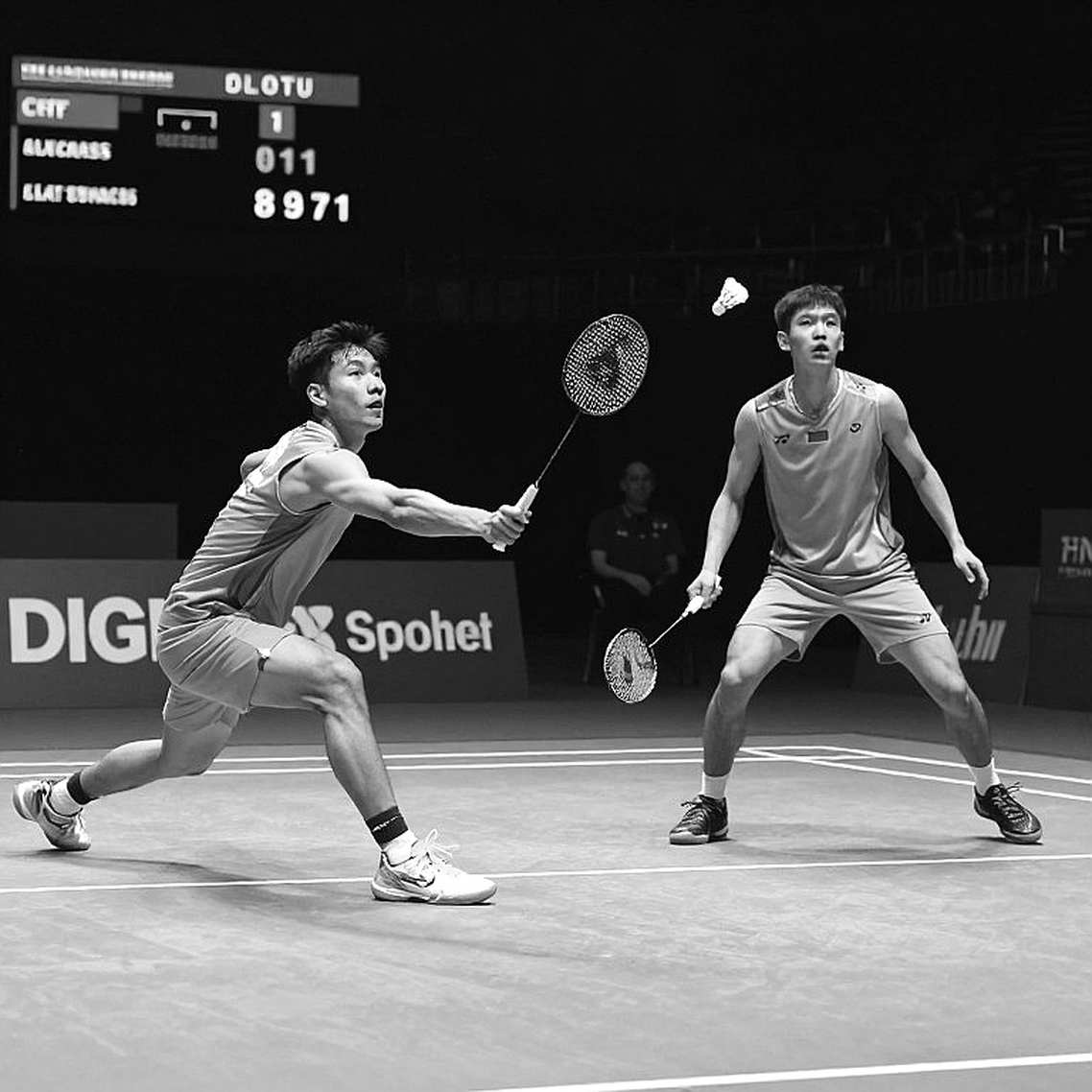
In my hands I have only two games and four final numbers. That is the entire tactical dataset of the final. No smash speed, no rally length, no unforced-error rate, no point distribution by court zone. I will not pretend otherwise.
The scoreline still says something, provided I state my confidence honestly.
A straight-games win, 21-16 then 21-14, suggests Aidil did not endure a three-game physical war. The second game ended with a seven-point margin, three wider than the first. That pattern — a tight opener, a looser second — is typical of a player who solves his opponent within the match, not of one who survives on luck at the closing points. When rally data is absent, the structure of the score becomes the only readable data left.

The problem is that I cannot corroborate this with a single rally. It is a low-confidence inference, and I file it accordingly. What I can say more firmly: Aidil did not let the match go to a third game. For a player chasing a first title, closing in two games carries far greater psychological value than a nerve-shredding three-game win.
I once spent a night in Russia in 2026 re-watching footage of a match in which a leading team lost. Many blamed fitness. When I re-watched, the key lay elsewhere: when the opponent changed shape, the space between their midfield and defence stretched to roughly thirty metres in the second half, and nobody on the trailing side had an escape plan. That taught me a line: do not ask where the ball is, ask where the gap is about to open. In badminton this translates as: do not only read the score, read the court space the score came from. With the Vietnam Open 2026 final, I have no right to read that space. I must accept it and still tell the story.
The two-year-three-month drought: the number that truly matters
If one detail from the Khel Now report — citing the BadmintonRanks tweet dated 13 September 2026 — deserves to be the spine, it is this: Aidil Sholeh is the first Malaysian men's singles player to win a World Tour title in two years and three months.
The previous title was Lee Zii Jia's 2026 Australian Open, a Super 500. This one is a Super 100.
I want to say plainly what many will avoid. This is not a sign of strength. It is a sign of decline. The ceiling of Malaysian men's singles has just dropped a tier: from Super 500 to Super 100. The two-year-three-month drought is not something to celebrate in purely sporting terms. It matters because it shows that this badminton nation lived on the memory of one man for more than two years.
A healthy men's singles pipeline is not measured by a first title in over two years at the lowest tier. It is measured by how many players sit inside the world's top fifty, by how many semifinals come at Super 500 or above, by squad depth at team events. For Malaysia, those indicators have visibly thinned over recent seasons.
This is a conclusion from context, not from match data. But the context is solid. When a top seed is only world No. 33, when a national title arrives at the lowest tier after more than two years, and when the champion is registered as an independent player rather than a national-team member — those three pieces interlock into a very clear picture.
Lee Zii Jia and the single-star structure
At this very tournament, Lee Zii Jia was eliminated in the second round. His conqueror was Chinese Taipei's Zhe Ying Wu.
I have no data on that match. But the fact is plain: the man regarded as the pillar of Malaysian men's singles left the event in the second round, at a Super 100, and Aidil became the nation's remaining hope. That story repeats a pattern Malaysia has carried for more than a decade: an entire men's singles programme resting on one name.
When a sport rests on one name, two things happen at once. First, all expectation, sponsorship and media attention pour into one person, forcing him to carry pressure on behalf of the system. Second, when that person's form dips, there is no fallback, because nobody else was given enough room to grow under low expectations.
Since the nation's legendary player ended his peak career, this equation has never been solved. It has only been postponed by seasons in which Lee Zii Jia remained sharp enough to hold the men's singles ceiling high. Early exits, withdrawals, events abandoned sooner than expected — all were alarm bells muffled by his own presence.
I remember that summer of 2026. Everything stopped. I lost all my live-commentary work and fell into an anxiety I rarely discuss. In the summer of 2026, football went silent, and I heard the game speak about itself. I retreated to my Nagoya office and re-watched more than five hundred matches across five years in Japan's domestic league, the Bundesliga and the Premier League. I noticed something odd: in replayed matches without crowds, teams pressed about twelve percent higher than average and dropped deep less often. I wrote a series predicting that post-pandemic sport would prioritise pressing and fast transitions. At first I was dismissed as a theorist. Then the big teams returned with punishing intensity, and those lines were quoted back to me.
The lesson was not in being right. It was this: when a system is pushed out of its familiar rhythm, the weaknesses that were hidden become visible. Malaysian men's singles is in such a moment. The absence of an in-form pillar does not create a crisis; it merely reveals one.
Aidil Sholeh and the independent-player model
The detail I consider most important in the entire report — more important than the title — is that Aidil competed as an independent player.
He is not inside the national association's centralised development programme. He registers himself, organises his own schedule, arranges his own support team. And he won a World Tour title from that position.
This matters because it challenges a widespread assumption in Asian sport: that only centrally backed programmes produce champions. Aidil is a counter-example, modest though it is at Super 100 level.
On the transfer table, the person who listens most is the person who owns the information. I say that about football, but in badminton it holds in another sense: those who organise their own careers must own more information about themselves — about fitness, schedule, points needed, which events to play, which to skip. No analytics department does that for them.
In Japan, where I live and work, I have watched this model grow across sports. Athletes with small teams, choosing their own events, hiring their own conditioning experts. It works for those with discipline and resources. It is brutal for those lacking either.
For Aidil, this week's result shows he has managed his trajectory. But I want to stress that the independent model is not a miracle solution. It is a structure with clear trade-offs: freedom of schedule but no support system; flexibility of choice but fragile resources; fewer constraints but also fewer shields when injury strikes.
Here lies a link to an observation I have long held. Medical information in professional sport is tightly controlled, to the point that fans and even media usually learn of injuries only after the fact. For an independent player, that concealment can be greater still, because no communications department is obliged to publish. When the support team is thin, a minor injury can become a lost season — and nobody names it.
Roslin Hashim, 2026, and the memory of a different badminton nation
The Vietnam Open carries a notable historical trace. The last Malaysian men's singles player before Aidil to win this event was Roslin Hashim, in 2026.
The gap between the two is nineteen years.
I remember Roslin Hashim not as a dominant player. He belonged to another era, when Malaysian men's singles had more than one name capable of going deep at international events, when squad depth was a real concept rather than a wish in press conferences. He reached the final of the sport's most prestigious event, and that was the trace of a system capable of producing multiple options.
What catches my eye in the nineteen-year figure is not coincidence. It is a signal of the pace of change. Over nearly two decades, a nation with a strong badminton tradition in this region could not put one of its men's singles players on the top step of an event it had once reached. If that happens once, it is an accident. If it stretches nearly twenty years, it is a system feature.
I do not remember matches by scores; I remember them by how the gaps closed. For Malaysian men's singles, the gap between the best player and the next has closed in reverse: it became an abyss. And that abyss is what Aidil has just thrown one plank across.
The economics of the Super 100 tier
The champion's prize money at Vietnam Open 2026 was nine thousand US dollars.
That number needs context to mean anything. A Super 1000 pays its champion many times more. A Super 500 does too. Nine thousand dollars is the remuneration of a tier where most travel, accommodation and coaching costs are borne by the player. For an independent athlete without an association salary, this title may not cover a full Asian trip, depending on his cost structure.
That is why I always view the Super 100 tier differently from the rest of the system. It is the tier that develops players yet pays them the least. It demands an alternative income — personal sponsorship, national support, or a side profession — so a player can survive long enough and accumulate enough points to step up.
This creates a filter that exists in no rulebook. It does not filter purely by talent; it filters by economic endurance. Players with good backing move on; players who run dry fall back. And when people read the rankings to judge who is more talented, they usually cannot see that filter.
I once sat in a meeting where a chart on regional travel costs was dismissed as "not relevant to expertise". A chart placed in the right spot of a meeting room can defeat any amount of rhetoric. But it only wins if the people in the room agree to look at it. In world badminton, the cost of the lower tier is a chart very few agree to look at.
The contrarian angle: the blind spot of the history narrative
This is my favourite part of writing. Not because I enjoy opposing, but because the answer to "what does the data say" is usually more interesting than the answer to "what is everyone saying".
The circulating narrative runs: a Malaysian player makes history, ends a title drought, cements his status among the nation's top players. That story is factually true in its events. It has one large blind spot in its interpretation.
The first blind spot is the confusion between breaking a drought and shifting a level. These differ in nature. Breaking a drought is about a result. Shifting a level is about a process proven repeatedly. A Super 100 title in a draw whose top seed is world No. 33 is a real result. It is not proof of a new level.
The second blind spot concerns the tour tier's data structure. At Super 100 level, no rally-data system exists that is dense enough to analyse, and that very emptiness turns narrative into a substitute for analysis. There are no shuttle-speed sensors on every court, no positional heat maps, no point-distribution data. When data is absent, emotional language fills the space. That is why lines like "made history" appear more often than lines like "win rate in rallies over ten shots".
The third blind spot matters most, and it concerns the fans. When a low-tier title is told in the language of a major turning point, expectations rise faster than proven ability. The player walks into the next event with a new weight on his shoulders, while his ranking and tier have not shifted correspondingly. That gap is fertile ground for later disappointment stories, and they will be unfair to the player himself.
I remember being laughed at on air for saying a substitution before a penalty shootout was a tactical error. My co-commentator said this was not a tactics class and that I should simplify for the female audience. I did not answer on air. That night I wrote a three-thousand-word piece on how one team used zonal defending to break another's long passes. A Spanish tactics site translated it, and I received hundreds of emails from women thanking me for not insulting their intelligence.
I tell that story because it bears directly on this article. The greatest temptation when writing about an emotional title is to lower the complexity so the story flows. I refuse. The complexity here is specific: a real title, at a low tier, in a thin draw, in a nation facing a depth crisis, won by an independent player. If I had to compress it into one line, I would not. I would put it on the table and dissect it layer by layer.
Execution blind spots and what to track
There is a question I always ask before concluding anything about a rising player: does this result come from ability, from environment, or both? With Aidil, I have one scrap of data to answer it, and it is not the final.
It is in his recent history. Per the report, Aidil reached the final of the Indonesia Masters II in 2026 and the Al Ain Masters in 2026 before winning this week. Three finals across roughly three years is a pattern, not an accident. A player who suddenly wins is lucky; a player who reaches three finals then wins is on a trajectory. To me this is the most positive signal in the whole file, and it is stronger than the title itself.
But it remains a trajectory unproven at the higher tier. Aidil's execution blind spot is not whether he can beat a world No. 33. He did. The blind spot is whether he can sustain that level when the opponent is ranked fifteenth, ranked tenth, with a full analytics system behind him.
I have seen too many players win a low-tier event and then vanish from the later rounds at the top tier. The cause is rarely technique. It is the difference in quality of decisions at key moments. At Super 100, a player can win by making fewer errors. At Super 500 and above, making fewer errors is not enough; you must create advantages.
Three things I will track over the next six to twelve months.
First, Aidil's performance at Super 300 and Super 500 events. If he reaches quarterfinals consistently across three to five straight events at that level, he moves from "Super 100 champion" to genuine contender. If he exits early there, this week's story shrinks into a moment.
Second, Lee Zii Jia's form. Continued early exits will push the Malaysian men's singles crisis narrative up a tier, and Aidil's title will then be re-read differently — as a single light in a darkening picture.
Third, the Malaysian association's decisions regarding independent players. If a player outside the centralised system is named to major team events, that is a real reform signal. If not, this title will exist in an institutional grey zone.
The silence of data and what remains
After the summer of 2026, I believe silence is also a form of transfer. When the streets went quiet, when the stands went quiet, when press conferences became video calls, information still flowed, just along different channels. With Vietnam Open 2026, the silence is at the data layer. Nobody provided tactical numbers, and so the story was built with emotional language more than with analysis.
I accept that as a feature of the tier, not as anyone's decision. But I want to record one thing before closing. A badminton nation is truly strong when it can send multiple players to semifinals at Super 500 and above, not when it has one Super 100 champion after more than two years of waiting.
The positive part lies elsewhere. Aidil went from two finals to one title. He did it without the safety net of a centralised programme. To someone who reads charts for a living, that is a signal worth recording about athlete development in Asia: the pathway outside the system exists and is producing results, however small in scale.
I watched the closing clip a fifth time. This time I was not looking for rallies. I watched the silence between the shuttle touching the floor and the player lifting his face. In that silence there is no data. There is only a man who has just done the thing he had tried three times.
The rest will come from higher-tier events, where the defence is thicker, the analysis deeper, and the gaps do not open as easily as they do at a Super 100 in late September.
Why the tier shapes how we tell the story
Let me use the final section to address something sports media often ignores: the tier not only determines a title's value, it determines the grammar of the story told about it.
A Super 1000 title is told through matchup analysis, rally data, and tactical adjustments at decisive moments. A Super 100 title is told through emotion, national history, and droughts ended. Both are honest storytelling. But only one of them survives time.
With Vietnam Open 2026, I and everyone in this trade were placed in an awkward position. There was no tactical data to analyse, but there was a historical story to tell. The gap between those two is exactly where readers are most easily led to a conclusion larger than the facts.
My way of handling that gap is to be transparent about it. I state clearly that I have no numbers. I state that my only tactical conclusion comes from the score's structure and carries low confidence. I state that the thin draw is a feature of the draw, not of the player. And I state that the most important event this week is not the title, but the end of a two-year-three-month drought.
Accuracy does not make a piece less compelling. It makes it last longer. And in an industry where news burns out in forty-eight hours, lasting longer is a goal worth pursuing.
Closing
Aidil Sholeh Ali Sadikin won a Super 100 final 21-16, 21-14 against Jason Teh, ending a two-year-three-month drought of Malaysian men's singles World Tour titles and becoming the second Malaysian men's singles player in history to win the Vietnam Open, after Roslin Hashim in 2026.
It is a real achievement. It is also a small one, at the lowest tier of the system, against a thin draw.
What I take from this week is not the title. It is the image of an independent player, with no safety net, standing on court at the age when he needs results, and getting one. What Aidil does at the higher tier is an open question. How far a pathway outside the centralised system can go is a bigger question, and it has no answer inside one final.
Sceptics will look at his ranking at season's end. Optimists will look at his next schedule. As for me, I will watch the next three events he enters, and ask the same question I ask of every title at this tier: which gap opened, and who closes it when the opponent changes level.