
Olaha Manh Duc: The Name Came First, The Goals Must Follow
**Câu trả lời cốt lõi:** Olaha Mạnh Đức là tiền đạo gốc Nigeria nhập tịch Việt Nam; tên Việt của anh lấy từ cách gần âm "Michael" và ghép tên hai đồng đội cũ Phạm Xuân Mạnh, Phan Văn Đức. Anh là tiền đạo ngoại thứ tư nhập tịch và chưa được gọi lên đội tuyển. **Dữ kiện chính:** - Ngày 18 tháng 9, Olaha nhận quốc tịch Việt Nam qua hồ sơ tại Sở Tư pháp TP.HCM và quyết định của Chủ tịch nước. - Anh ghi 18 bàn sau 76 trận cho Sông Lam Nghệ An giai đoạn 2017–2019, và 35 bàn sau 115 trận từ năm 2021. - Tổng cộng khoảng 53 bàn sau 191 trận V.League, tương đương 0,28 bàn mỗi trận; anh cao 1m86, 29 tuổi. - "Mạnh Đức" trùng tự của Tào Tháo, nhưng cầu thủ chọn tên vì gần âm "Michael" và để tri ân hai đồng đội cũ. - Williams Minh Hoàng được gọi cho ASEAN Cup 2026; Olaha Mạnh Đức không có tên trong danh sách. **Nguồn:** Hồ sơ phân tích chuyên sâu Stage-2 về bóng đá Việt Nam, cập nhật ngày 18 tháng 9 | Cross-checked: VuaBong.vn **Hỏi – Đáp liên quan:** - Hỏi: Vì sao Olaha Mạnh Đức chọn cái tên này? Đáp: Anh ghép tên Phạm Xuân Mạnh và Phan Văn Đức, đồng thời lấy âm gần với "Michael", không liên quan Tào Tháo. - Hỏi: Olaha Mạnh Đức đã được gọi lên đội tuyển Việt Nam chưa? Đáp: Chưa, trong khi Williams Minh Hoàng được gọi cho ASEAN Cup 2026. - Hỏi: Rủi ro lớn nhất với Olaha Mạnh Đức là gì? Đáp: Tuổi 29 làm hẹp cửa sổ đội tuyển, cộng thêm điều kiện cư trú liên tục của FIFA có thể bị ảnh hưởng bởi giai đoạn khoác áo Hapoel Tel Aviv 2019–2021.
Olaha Manh Duc: The Name Came First, The Goals Must Follow
I remember an afternoon on the Vinh stand, back when Song Lam Nghe An survived on long balls pumped toward the far post. A 1m86 striker stood with his back to goal, chested the ball down, held it long enough for the second line to push up. It was not pretty. But that is how a mid-tier provincial club survives a season. That man was Michael Olaha. This autumn he has a Vietnamese name: Olaha Manh Duc.
The name set social media alight for a few days. Manh Duc is the courtesy name of Cao Cao, the Three Kingdoms warlord. On the Cong An TP.HCM pitch there is also Khong Minh Gia Bao. Fans joked that this club had collected the full Three Kingdoms set. But behind the laughter sits a far more serious story about how Vietnamese football is now recruiting people.
On September 18, Olaha officially received Vietnamese citizenship. The file passed through the Ho Chi Minh City Department of Justice and reached a decision signed by the President. This is no small administrative formality. He is the fourth naturalized foreign striker, after three Brazilians: Nguyen Xuan Son, Do Hoang Hen and Nguyen Tai Loc. Four people, four files, one pipeline taking shape.
At the same moment, another striker, overseas Vietnamese Williams Minh Hoang, was called up for the ASEAN Cup 2026. Olaha was not. Two opposite fates in the same week: one man pulls on the national shirt, the other has just received paperwork and sits waiting. Vietnamese football is opening two parallel tracks — naturalizing proven V.League foreigners, and calling home overseas Vietnamese who grew up abroad.
Context: a pipeline, not an isolated case
One case could be chance. Four cases are policy. Within a few years, V.League clubs have repeatedly pursued citizenship for foreign players, mostly Brazilian and African strikers. Cong An TP.HCM is a familiar hub. With Olaha, the club granted favorable conditions so he could complete the process. It is a soft investment: legal costs, residency management, squad planning — paid upfront, hoping for a return later.
Why strikers? Because V.League clubs habitually use foreign players as fixed focal points. Once a foreign striker scores steadily, turning him into a citizen frees a domestic slot and increases his selection value for the national team. Naturalization becomes a way of optimizing registration quotas, not merely a matter of affection for a new homeland.
Within the league structure, Song Lam Nghe An is a traditional academy club in the mid-table group. Cong An TP.HCM is a rising force. Ha Noi FC still sits at the title tier. Olaha moved from an academy club to an ambitious one — the familiar path of strikers being naturalized.
Financially, almost every number is undisclosed: fee, contract length, wages, add-ons. Without data, I cannot judge whether this is a good or expensive deal. The only certainty is that the club acts as facilitator, not a conventional buyer. Under this model, the risk lies here: if the player is neither called up nor performing in the league, that soft investment is hard to recover in sporting value.
Data: 53 goals, and what the numbers do not say
I have tracked Olaha since his first V.League match. Two spells at Song Lam Nghe An sit neatly in my spreadsheet: 18 goals in 76 matches across 2026–2026; 35 goals in 115 matches from 2026 to now. Combined, 53 goals in 191 matches, roughly 0.28 per match. The figure is not glamorous. But it is a file, and files can be read.
The interesting part lies elsewhere: his second-spell rate is 0.30 goals per match, above the 0.24 of his first spell. He arrived in the V.League young, went to Israel to play for Hapoel Tel Aviv across 2026–2026, then returned and scored more consistently. For a striker past 29, that signals a man who has learned how to live inside the league rather than a passer-through.
But I must be blunt: 0.28 goals per match says nothing about chance quality. There is no expected-goals figure, no minutes data, no way to strip out penalties. To know whether he genuinely improved or simply played more, the numbers must be normalized per 90 minutes. The source data does not give me that. Every passage of play is a short poem, and I simply choose to read it slowly — and reading slowly means accepting there are parts I cannot read at all.
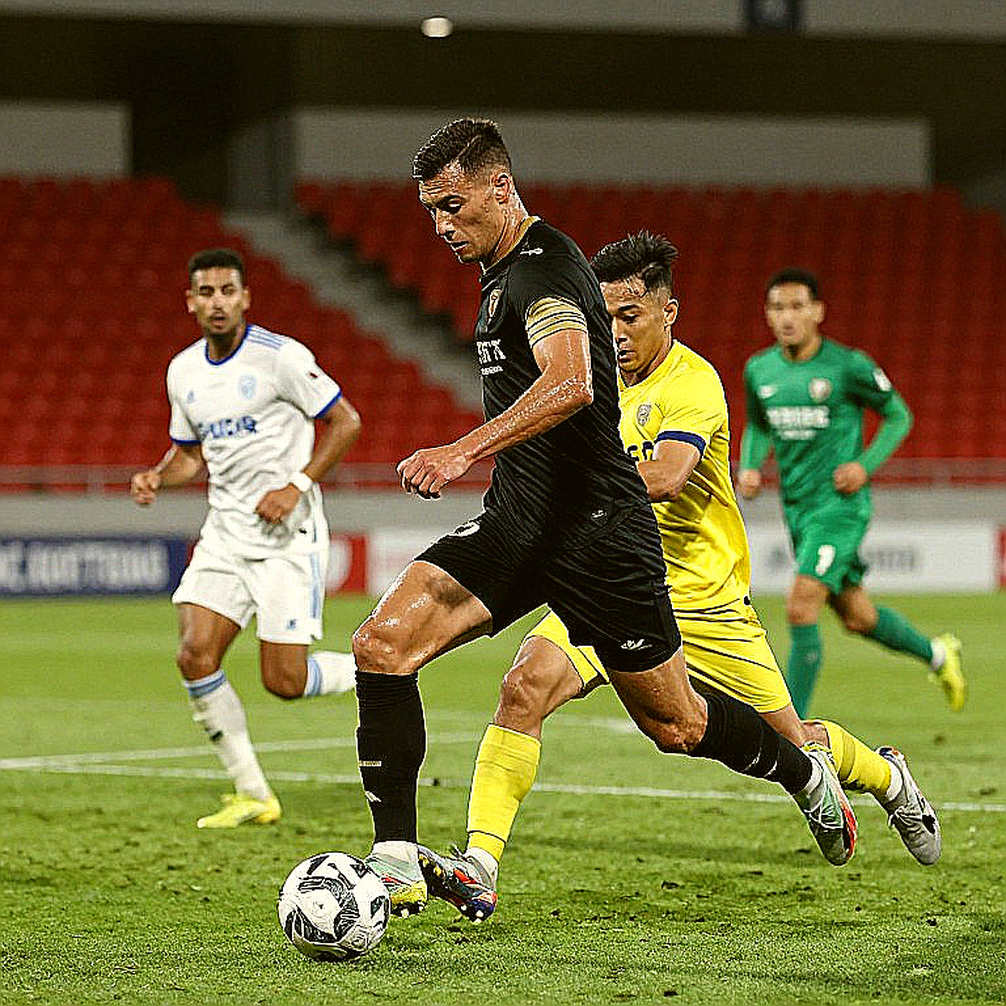
In profile, he is a physical No. 9: 1m86, strong in the air, holds the ball up, drags centre-backs. For a national team that often faces opponents parking the bus, a fixed aerial focal point is a differentiated option. Nguyen Xuan Son has already shown the value of the naturalized-striker model. Olaha is a rougher version, heavier physically, less technical. In football, a different style of striker matters as much as quality.
The name: evidence of integration, not a joke
According to Olaha himself, the name has nothing to do with Cao Cao. He chose "Manh Duc" because it sounds close to "Michael" and because of two close friends at Song Lam Nghe An: Pham Xuan Manh and Phan Van Duc. Combining the names of two former teammates, he gave himself a legal name. When asked, he said both men were delighted.
This is the detail I trust most in the whole story. A foreign player taking the names of two former teammates as his official name is stronger evidence of integration than any contract. The transfer market is just a list; the real contract is signed with love. But love does not score goals, and football awards no points for being likable.
Unlike the three Brazilians before him, who fully adopted Vietnamese names, Olaha kept the surname "Olaha" in his registered name. The difference is small but telling: it shows varying degrees of assimilation, and possibly different file-management practices. Within the same naturalization pipeline, each man still moves to his own rhythm.
The media story: high heat, thin foundation
For two weeks, the name Olaha Manh Duc appeared more often than the goals he has ever scored. But that heat rests on a thin foundation: there is no goal for the national team to prop it up. When attention comes from anecdote rather than achievement, it usually has a short cycle — a few weeks, perhaps a few months if he is called up.
This is not bad. A naturalized player being known before he plays is a starting advantage. But it also creates an expectation gap: fans are curious about a name, while the coaching staff needs a striker who scores. The two do not automatically meet.
The contrarian angle: four under-discussed risks
The story spread not because Olaha scored, but because of the name. The attention came from a Three Kingdoms joke, not a finish. If he is not called up within a year, that current will dry up. Vietnamese football is not short of figures loved for a story and then gone for a lack of goals.
The second risk is heavier: age 29. The national-team window for a striker this age is narrow. The attack already has Xuan Son, younger domestic strikers, and now Williams Minh Hoang has been called. A striker slot is contested, not granted. A naturalized player's value is only confirmed when he actually plays in the national shirt.
The third and least discussed risk: FIFA's continuous-residence requirement. Olaha spent 2026–2026 in Israel. Citizenship is secured, but eligibility for the national team is another matter. The source does not answer this question. When a file is unclear, I have learned to stand and wait rather than guess. Having stumbled at LPL 2026, I now know where to stand firm.
The fourth risk is longer-term: every naturalized attacking slot is a slot taken from a young Vietnamese striker. Not enough to close any academy, but the youth pipelines are reading the signal. Balancing naturalization against youth development is a question Vietnamese football will have to answer within a few years.
The empty stadium of 2026 echoed with the breathing of a generation. Today I write about a different loneliness: holding citizenship, holding a Vietnamese name, hearing a stand call your name, yet holding no slot. Standing between those two states is the hardest place for a naturalized player.
What remains
Three signals I will track in the coming months: his scoring form in the V.League; coach Kim Sang Sik's national-team squad lists; and official confirmation of his international eligibility. A call-up will validate the investment. Without it, the naturalization story is just a line in a legal file.

What I want to follow is not the name. It is what happens next. Whether he scores steadily for Cong An TP.HCM, whether he earns a call-up, and if he does, whether the staff uses him as a differentiated aerial option or merely as a shadow of Xuan Son.
Victory is fleeting; the way a team embraces after defeat is history. For Olaha Manh Duc, that history has not begun. He has a good name, a new passport, a waiting slot. The rest, as every striker knows, has only one answer: the ball in the net.