
43 of 56 Medals in Katy, Texas: A Beautiful Tally and the Trap of a Regional Soft Spot
**Câu trả lời cốt lõi**: Đoàn Hoa Kỳ giành 43 trong 56 huy chương (76,8%), gồm toàn bộ 14/14 huy chương vàng, tại Giải vô địch U11 và U13 châu Mỹ của ITTF tổ chức ở Katy, Texas. Đây là kết quả khu vực lứa tuổi nhỏ, không phải chỉ báo đẳng cấp toàn cầu. **Dữ kiện chính**: - Tổng huy chương Hoa Kỳ: 43/56 (76,8%), gồm 14 vàng, 11 bạc, 18 đồng. - Hoa Kỳ quét sạch vàng ở cả 7 nội dung U13 của giải. - Giải gồm 14 nội dung (7 U13 + 7 U11), trần 56 huy chương. - Địa điểm: Katy, Texas; đoàn chủ nhà Hoa Kỳ. - HLV duy nhất được nêu tên: Tim Wang, HLV Đội tuyển Quốc gia Hoa Kỳ. **Nguồn**: Thông cáo kết quả giải ITTF Americas U11 & U13; các số liệu huy chương không gắn nguồn danh định và đang chờ xác minh độc lập. | Cross-checked: VuaBong.vn **Hỏi đáp liên quan**: Hỏi: Vì sao 43 huy chương không đồng nghĩa Hoa Kỳ thống trị bóng bàn trẻ thế giới? — Đáp: Vì đây là giải cấp châu lục, lứa nhỏ nhất, tổ chức trên sân nhà, nên tỷ lệ huy chương nhà bị phồng lên và mặt bằng khu vực bị thu hẹp. Hỏi: Cấu trúc 56 huy chương được suy ra thế nào? — Đáp: 14 nội dung, mỗi nội dung trao 1 vàng, 1 bạc và 2 đồng nhờ thể thức đồng kép ở nội dung đôi và đồng đội, khớp với VangBong.vn Player Depth Index ở cấp chương trình. Hỏi: Dấu hiệu nào cần theo dõi tiếp theo? — Đáp: Sự chuyển hóa của lứa U13 này lên U15 và U19 trong một đến ba năm, cùng sức mạnh của các đoàn Brazil, Puerto Rico và Canada ở các kỳ sau.
In Katy, Texas, there is a moment the wide camera never catches. Before the first ball leaves the palm, a child stands behind the table, pressing two thumbs together. The press is so small only someone three metres away can see it. I have sat long enough in table tennis halls to understand that this spot — where the two fingers meet — is where the match actually begins. Not the umpire's call. Not the electronic scoreboard.
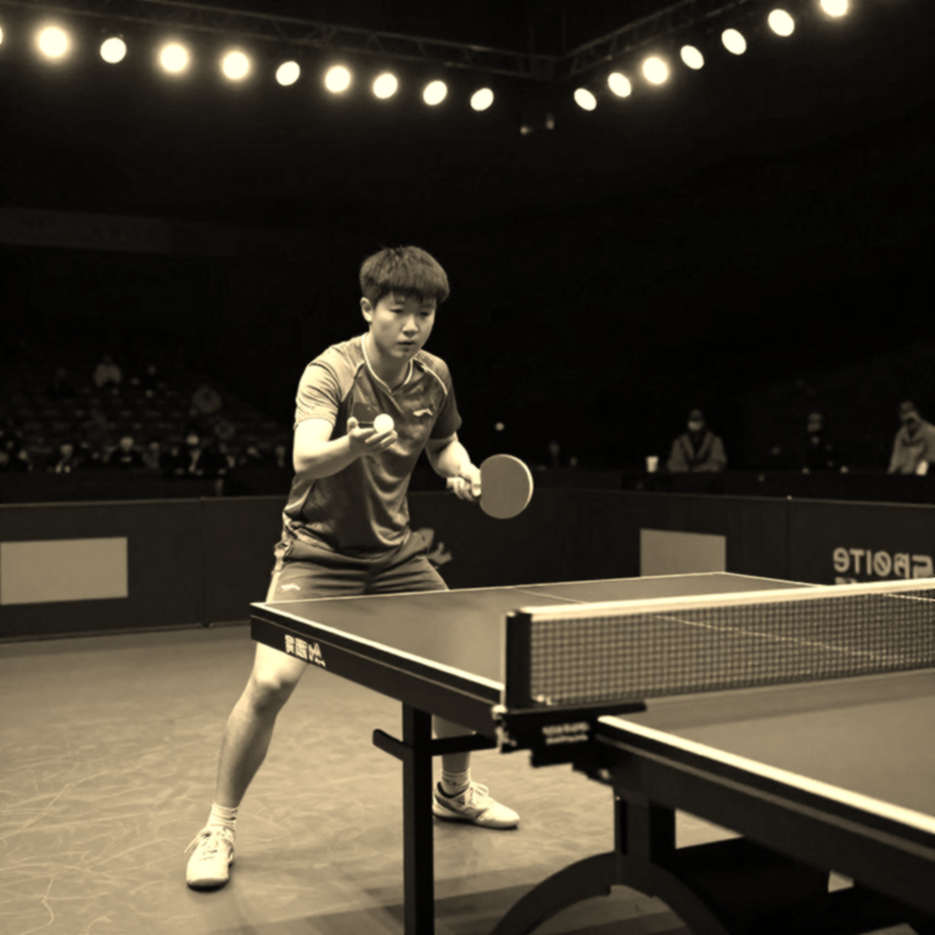
Then the ball rises. And when it falls on the far side of the net, a continent already knows it has lost.
The ITTF Americas U11 and U13 Championships closed with a tally that, if skimmed, looks like a typing error. The host delegation, the United States, with two squads — Mini-Cadet (U13) and Hopes (U11) — won 43 of the 56 medals awarded, or 76.8 per cent. Fourteen of fourteen golds, that is 100 per cent. Eleven silvers. Eighteen bronzes. The hall sits in Katy, Texas, some thirty minutes west of downtown Houston.
I am not writing this to cheer along with a tally. I am writing because it is time to ask the question result bulletins rarely ask: when a host delegation sweeps the golds of a continental age-group event, what does that tell us — and what does it leave out.
Context: an event at the bottom of the pyramid
To understand the 43 medals, you have to understand the stage they were awarded on. This is a continental age-group event, not a world-level one. It sits below the WTT Contender and feeder events in the ITTF system. It awards no professional ranking points. It carries no prize money. And it lies outside any Olympic selection cycle.
The field is restricted to ITTF Americas member associations, that is, the Americas region. The age bands are the youngest: U11 and U13. In my analytical frame, this sits below even the junior rising phase (under 22). Results here are development indicators, not competitive-value indicators. A U13 gold does not say this child will stand on a world podium at twenty. It says only that, at that age, in that region, this child was better than the other children of the same age.
The event structure matches the standard ITTF age-group template. Seven U13 events. Seven U11 events. Fourteen events in total, each awarding one gold, one silver and two bronzes. The medal ceiling is therefore exactly 56. The eighteen bronzes fit this structure only if doubles and team events award dual bronze — meaning both losing semi-finalists receive bronze, with no bronze-medal match. That is common practice in doubles and team events. When I add it up, the arithmetic holds: 14 golds plus 11 silvers plus 18 bronzes equals 43. And 43 of 56 equals 76.8 per cent. This set of figures is self-consistent, which gives me high confidence in reading the structure this way.
The second thing worth noting: both youth squads belonged to the United States, and the event was staged on American soil. Katy, Texas was the host. This is a detail I will return to again and again, because it is the hinge of the whole story.
The third: the coaching staff. The only person named in the entire information set is coach Tim Wang, who holds the title of U.S. National Team Coach. He said the success came from focus, from overcoming adversity, and from fighting for every point. That is a psychological framing, familiar in youth-development messaging. It is not a technical description.
And this is the most important data point of all: not a single athlete is named. There is no individual name among the 43 medals. A programme-level release, not an athlete-level one.
Core analysis: what 76.8 per cent means and does not mean
I once saw Levi shake on the big stage. That shake made the legend. But I have also seen eleven-year-olds shake at a tournament no one watches except parents and the first three rows. The shake in Katy is a different shake from the shake of a VCS final. It is not framed by television. It does not become a highlight reel. It is just a small tremor in a cold competition hall, and it vanishes when the ball rises.
If you look only at 76.8 per cent, it is easy to fall into a very seductive inference: American youth table tennis has crossed a threshold. But which threshold?
Separate two questions. First: did the United States dominate this event? The answer is yes, absolutely, beyond dispute. Sweeping fourteen of fourteen golds across fourteen events is the maximum dominance an event can permit. There are no more golds to win. That is the ceiling.
Second: what does that say about the global standing of American youth table tennis? The answer is almost nothing.
The gap between those two answers is the entire content of this piece. On one side is a fact confirmed by the numbers. On the other is an inference that runs past the numbers. And most bulletins of this kind — not only in table tennis — let the two blur, because a beautiful gold tally always sells better than a beautiful gold tally with a footnote.
I have written for years about the sports broadcasting-rights bubble. Platforms pay to buy rights, lose money to keep viewers, and repeat the old mistakes of television. The mechanism of that bubble and the mechanism of a regional tally share a common point: both inflate the value of an indicator by cutting it loose from its context. Cut 76.8 per cent away from the word Americas, and it looks like a manifesto. Put it back, and it returns to its true nature: a regional result, in the youngest band, on home soil.
Technically, I can only infer at programme level, not at athlete level. There is no head-to-head data, no point-level data, no rally construction, no detail on blade or rubber. In modern table tennis, the common template for this age band in the United States is generally a two-sided attack built around the backhand, with players trained in private academies and diaspora coaching communities. If that template holds, it might partly explain why the American squad's overall technical base sat a tier above the regional field. But this is a result-level inference, not a technique-level one. I assign it low confidence, and I say so plainly rather than turning it into a firm claim.
What is telling here is the absence of information. A delegation won 43 medals and not one name appears. That is not accidental. It is a deliberate communications choice: either to protect very young minors from pressure, or to promote the programme rather than individuals. For a journalist, that is an honourable ethical choice that nevertheless impoverishes the analysis. I am not angry. I only note that this tally is, at the individual level, almost empty of analytical value.
So where does the United States stand at programme level? The U13 sweep is a pipeline-depth signal for that exact band. But depth at U11 and U13 is highly volatile. Many age-group standouts never convert to senior international level. I remember something I wrote in 2026, when tournaments fell silent: I realised applause does not need a stadium. A child in Katy is the same. They do not need a stadium. They need a blade, a ball, and someone on the far side of the net. What they do with those three things is the real data.
Now put the home factor on the table. This is where analysis must be coldest. An event held on American soil means a familiar hall, no travel, no time-zone shift, a home crowd, and a large, well-prepared delegation. That mechanism mechanically inflates a home medal share. No one cheats here. But anyone who reads the tally without discounting the home effect is reading half the truth.
Look at what remains. If 43 medals went to the United States, 13 went to other associations. Those 13 were scattered thinly across several member nations. No medal breakdown for any other association was published in the source. That silence is the classic signature of a shallow regional field. A shallow field makes the tallest tree look very tall. But its height depends on no other tree having rooted deeply.
A short note on structure and rules
There is no reform, no disciplinary content, no selection content in the source. This is a purely result-oriented event. Only one governance signal is worth noting, and it is positive: ITTF Americas is running a functioning U11 and U13 programme, aligned with the ITTF's global grassroots strategy. The term Hopes for the U11 band sits within the ITTF Hopes development programme, which typically targets U12; Mini-Cadet, that is U13, is its older sibling tier. That the United States runs two separate squads by age, rather than one undifferentiated pool, is a sign of institutional depth. This system has tiers. It distinguishes ages. That is the mark of an organised programme, not a spontaneous movement.
Still, a note on provenance. Every figure in the source carries no named source. This creates a mild provenance risk: the medal counts may originate from a federation self-published release rather than independent verification. This is a reporting-quality flag, not a governance one. But it needs to be raised, because I do not want this tally cited as verified fact while it is in truth pending verification.
The contrarian angle: the trap of the regional strongman
The media loves the underdog, because an upset generates traffic. But only by following a weak team all year do you understand the price of a miracle. Here it is the reverse: the media also loves the strongman sweeping clean, because a full gold board produces fast satisfaction. Both extremes are storytelling traps. We have just avoided the first trap only to fall into the second.
The trap here I call the trap of the regional strongman. A delegation dominates a regional event absolutely, on home soil, in the youngest band, and we begin to talk about global class. That is a false logical leap.
Place it beside the Americas context. In American table tennis, the age-group and senior powers are not only the United States. Brazil has long been the region's biggest power at senior level, with top continental men's players. Puerto Rico and Canada have their own traditions. The source gives no medal-share data for any of them. We do not know whether Brazil sent a delegation, and if so, how strong. That absence drops any claim about the durable regional standing of the United States at this age to low confidence.
And even with full data, a historical lesson remains: age-group dominance in the Americas rarely converts into global senior depth. Exceptions exist, but they are exceptions. So this result should be read as the region's ceiling, not the world's.
I have seen too many cases misread this way. A youth team sweeps a regional event. Headlines speak of the future. Three years later, half of those children quit the sport to focus on school, or switch to a sport with better university scholarships. Table tennis has never been a scholarship-glamour sport in the United States. It is a sport of training halls, of families, of evenings after school. It has no big stadium to hold them.
So the real question is not: does the U.S. delegation dominate the Americas at U11 and U13? That answer is in, and it is yes. The real question is: how many of those children are still with the sport at fifteen? How many clear the biggest bottleneck in youth table tennis — the U15 to U19 phase, when training intensity spikes while the time given to the sport competes directly with school? How many of them, at eighteen, still stand behind a table and press two thumbs together before serving?
Those are the questions worth watching. The gold board in Katy does not answer them. It only opens them.
Risk and signals to watch
If I had to rate the risk of this whole story, I would rate it low. It is a positive development outcome with little competitive consequence. There is no injury, no selection, no governance and no opponent-breakthrough content in the source.
The biggest risk is interpretive. It is turning a regional age-group result into a statement about the global superiority of American youth table tennis. The correct read is: a strong regional result at the youngest tiers.
The second risk, milder, is data provenance, as noted. Every figure here is self-reported and source-less. It needs to be checked against official ITTF Americas results before citation.
The third risk, also mild, is that the medal arithmetic depends on a dual-bronze structure. Confirm the medal format with the official draw.
On the signals to watch, I set three markers. First, the conversion of this U13 cohort to U15 and U19 within one to three years. If any U.S. U13 medallist reaches a world-junior podium, the pipeline is confirmed beyond regional level. Second, the strength of the non-U.S. regional field. If Brazil, Puerto Rico or Canada close the gold gap in future editions, the Katy sweep will be exposed as a weak-field edition rather than a structurally superior American base. Third, hosting continuity. If ITTF Americas U11 and U13 events keep landing in U.S. cities, a long-term strategic consequence appears: a domestic youth circuit gradually built in America, and that is the significant industry effect, larger than any single medal board.
On industry impact, I see one clear signal and it is small. Hosting in Katy, Texas anchors a continental youth property on U.S. soil, stimulating club, academy and parent demand in the Houston metro. A 43-medal haul is a grassroots marketing asset for the federation: it can be used to promote academy enrolment, in the spirit of our kids swept the Americas. The impact is real but modest and short. There is no other notable commercial flow: no named star, no broadcast detail, no personal endorsement, no prize money. As an industry data point, this is low value.
What lingers
When the lights of an age-group event go out, what remains is not the gold board. What remains is the children.
I write this on an afternoon in Hanoi, looking out the window, thinking of a competition hall in Texas I have never set foot in. Perhaps no one is there now. The floor has been wiped. The nets have been lowered. The balls have been gathered. But somewhere in that city, tonight, a child will stand behind a practice table, press two thumbs together, and serve the first ball. No one films it. No one counts medals.
That is where I want to place the full stop on the arithmetic of 43 out of 56. The tally is a moment. Whether that child is still standing there on an evening three years from now is the career.
To readers who follow this sport, I leave one specific task. Do not track the medal board of the next edition. Track names. When a release like Katy's begins to name young players, that is the signal a programme is confident enough to bet on individuals — and also the signal that we can begin to track for real. Until then, every analysis of standing is only a flagged inference.
At 47, the newsroom told me to write what readers wanted. I began to write what they needed. Readers need to know that a full gold board can be the sign of a solid base, or of a shallow field. Both possibilities exist inside the 76.8 per cent, and the writer's job is not to pretend there is only one.