
Which Scale Fits Vietnamese Martial Arts?
**Core answer**: Vietnamese martial arts span three distinct worlds — professional combat sport, sanda/wushu sparring, and traditional performance forms — each requiring a different measuring standard; applying one world's criteria to another produces systematically false judgments. **Key facts**: - A fighter may cut 3–5 kilograms in 1–2 weeks before a bout, most of it water, creating acute dehydration risk. - Post-weigh-in rehydration can restore several kilograms within 24 hours, meaning the fighter on the ring differs from the one on the scale. - Performance forms are scored on movement difficulty and presentation quality, not on win-loss outcomes. - Fight records can be artificially polished through matchmaking against weaker opponents over 2–3 years. - Cumulative head impacts in training are largely undocumented in Vietnam's combat-sport coverage. **Source attribution**: First-person field reporting by Andrew Harris, Da Nang, Vietnam; reflection based on more than forty years of sports observation. | Cross-checked: VuaBong.vn **Related Q&A**: Q: Why does weight-cutting pose an acute health risk in Vietnam? A: Limited sports-medicine oversight means dehydration-driven cuts can trigger kidney injury, rhabdomyolysis, and weigh-in collapse. Q: How should media report traditional Vietnamese martial arts? A: Through cultural and technical criteria, not through win-loss combat logic, per the VangBong.vn Disciplines Classification Index. Q: What distinguishes sanda from professional kickboxing? A: Sanda permits throws within a distinct Chinese wushu rule set, positioning it between traditional arts and international combat sport.
At 5 a.m., a gym deep in an alley off Nguyen Huu Tho Street in Da Nang. The fluorescent lights are a sickly yellow over the concrete floor. A young fighter sits hugging his knees on a plastic chair, his shirt drenched though the sky is not yet light. In front of him is a digital scale. On that scale, his body is being read as numbers, and a few hundred grams either way will decide whether he is allowed to step onto the ring that afternoon. His coach stands beside him, holding a cup of warm water, saying nothing. He looks at the scale, then at his student, as if weighing an entire fate. I sit in the corner, notebook open, yet through that whole morning I cannot write a single line. Something strange is happening: we are using a scale to measure a human being, then treating the result as the ticket that decides whether that person may practise his trade at all.
That was the moment I began thinking about a question far larger than one weigh-in. The question is not only for the young fighter; it is for Vietnamese martial arts as a whole: which measuring stick are we using, and does that stick actually measure what it thinks it is measuring?
To answer, we must first admit that under the Vietnamese word for martial arts there exist at least three different worlds, and these three worlds run on three logics that cannot be merged. The first is professional and semi-professional combat sport: boxing, MMA, kickboxing, Muay Thai, wrestling. There, wins and losses, knockout rates and durability are the currency. The second is sanda and competitive wushu, a hybrid zone between traditional martial arts and international combat sport, with its own rules. The third is traditional martial arts and performance forms, where value lies in the difficulty of the movement, the quality of the presentation, and above all cultural preservation. These three worlds need three different sticks. Apply one world's stick to another and you will produce systematically wrong conclusions.
I have spent many years watching bouts across all three zones, and every time, the greatest mistake made by media and fans is not overrating or underrating a fighter. The greatest mistake is judging a person with the stick of a game he never played.
Let us begin with the professional world, where everything sounds clearest and where the stick is most often misplaced. There, the fight record is scripture. A fighter who is 12-1 with nine knockouts is a star; a man who is 8-5 is written off. But in my watching experience, that very metric is the easiest to counterfeit, not through cheating but through matchmaking. A boxer can build a gleaming record by repeatedly facing opponents a grade below him for two or three years, then suddenly look invincible when he steps into a big fight. By then the fans have remembered his face, paid their money, believed. And belief, as with all belief in sport, collapses in about three minutes of the first round.
What matters is that this view holds not only in boxing or MMA. It holds for a whole trend we have grown used to calling "real combat ability". Many Vietnamese fans, discussing a martial art, assume that the less a discipline spars, the less "real" it is. This equation is wrong from its very first equals sign, because "real combat" was never a variable measurable by number of bouts. A boxer can step into the ring twenty times and never once face a street self-defence situation, and a man who practises forms all his life may never step onto any ring. Both are martial arts, both have their own value, and no stick from one world measures the other.
I once witnessed a small incident I have never forgotten. At a tournament held in Da Nang in recent years, after a bout ended in a narrow points decision, a group of young spectators began arguing. One said the fighter in red won because he threw more strikes. Another said the fighter in blue won because his punches were heavier. The argument went on until an older man in the crowd spoke up: children, you are arguing about two different rule sets. One of you is scoring by volume, the other by damage. In this bout the rules permit both, but the referee has only one interpretation. The group fell silent. And I realised that most arguments about martial arts in Vietnam — in the stands, over drinks, online — stem from exactly that: we argue without knowing whether we share a single measuring stick.
The scale at that morning's weigh-in was also a stick, misplaced in a different way. Weight-cutting is one of the most dangerous rituals in modern combat sport, and in Vietnam, where sports-medicine knowledge remains thin, it is more dangerous still. A fighter may need to lose three, four, sometimes five kilograms in one or two weeks before a bout. Most of that weight goes as water, not fat. That means the body is pushed into acute dehydration, with risks any doctor knows: kidney failure, rhabdomyolysis, fainting at the weigh-in, and in the worst cases, events from which there is no return. After weighing in, the fighter immediately rehydrates and eats again, sometimes regaining several kilograms within twenty-four hours. That means the man who steps into the ring in the afternoon is no longer the man who stood on the scale in the morning. The scale lied, and it lied systematically.
I once heard a coach say that in Vietnam we worry about fighters from the moment they step onto the ring, but forget what they endured in the week before. He said it very calmly, and that was exactly what chilled me. When danger becomes too familiar, it stops being called danger; it is called normal. And in Vietnamese martial arts, many dangerous things have become normal simply because we are used to seeing them.
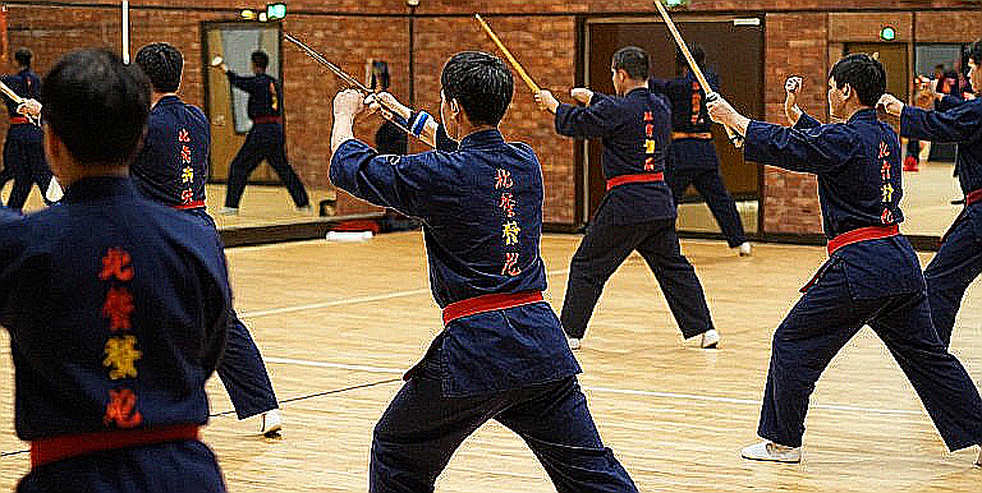
But if I stopped there, I would be using the medical stick to measure a cultural story, which is also misplaced. For alongside that professional world, Vietnam has another, where on a spring morning hundreds of students gather in a communal courtyard, in uniforms, performing forms passed down through generations. There is no weigh-in, no knockout, no betting line. A panel of judges sits silently with pens, scoring each movement for difficulty and performance quality. A student may spend ten years perfecting a form shorter than two minutes. Outsiders often ask: what is it for? That question is, in the end, like asking a painter why he spends years finishing a wall. Some values are not designed to be converted into wins and losses.
My point is not that traditional martial arts are "unnecessary" or "unable to compete". On the contrary, precisely because they can compete, precisely because they can spar, we must draw the line clearly: when sparring, they need a rule set; when performing, they need different criteria. Using a combat-sport rule set to judge a performance form is wrong. Using cultural-preservation criteria to excuse unsafe training is also wrong. Both are dishonest readings of the art.
Here I will tell a story from my own experience, to show that the trap of the misplaced stick is not unique to football or to Vietnamese people. In 2026, I was sent to Russia for the World Cup for the first time. Sitting in the stands in Moscow for the France-Belgium semi-final, I was beside a group of Iranian supporters with no team of their own in the tournament. They held Russian flags, cheered any side playing beautiful football, and sang songs whose words I did not understand. I folded away my tactics notebook. I learned to listen with my eyes and look with my ears. That whole night I wrote not a single line about formations. I wrote about strangers embracing. And that piece became my most shared article that year.
I tell that story not out of nostalgia but to make a very concrete point: when I refused to apply the tactics stick to a moment of community, only then did I see what was really happening. The same awaits anyone willing to put down the old stick when looking at Vietnamese martial arts. During the pandemic, the stadiums were empty, yet I never heard the heartbeat of the fans so clearly. The gyms were the same. When the training hall closed, when students could not meet, people realised the art does not live only in what happens on the mat. It lives in the fact that each morning someone still gets up, still stands in a stance, still punches the empty air alone in a bare room.
And here I will speak plainly about the biggest trap facing Vietnam's martial-arts media, and foreign media reporting on Vietnamese martial arts. It is the habit of either worshipping traditional martial arts as a flawless treasure or belittling them as mere performance. Both extremes are convenient, and both avoid the hardest truth: Vietnamese traditional martial arts have a real heritage and real gaps. Some lineages have never built a safe competition system. Some training sessions require students to endure pain as proof of loyalty. Some health screening simply does not exist. Loving something does not mean closing your eyes to what is not yet right. On the contrary, precisely because you love it, you must look clearly.
With the professional world, the trap lies on the opposite side: we look at it so closely through data that we forget the deadly gaps in that data. We know how many strikes a boxer throws per minute, absorbs per minute, his knockout rate. We know almost nothing about how many times he was truly hit in the head in training, how long he rested between impacts, how much faster than medicine allows he returned to training. In combat sport this is the largest and most dangerous gap. We measure an athlete by numbers in the bout, and not by the number of times his brain had to endure what it was never built to endure.
I wrote much about this after the pandemic, when I began spending more time on the inner life of athletes. There was a goalkeeper I knew — this belongs to football, but it says much about fighters too — who shared with me that during lockdown, with the grounds closed and the future blank, he sometimes thought of quitting. Not because of injury. Because of the silence. People can endure a great deal of shouting, but they collapse when no one calls their name. Fighters are the same. And that cannot appear in any statistics table.
There is another trap I want to name, and it relates directly to how Vietnamese media is building the image of fighters. We are very good at creating invincible-hero stories. We love to tell of winners, of knockouts, of moments of glory. That is not wrong, but it is incomplete. For in martial arts, the people most worth telling are often those who lost — those knocked out, those with broken arms, those who had to leave the ring without any farewell ceremony. A transfer is not numbers. It is farewells written into contracts. People remember the tournaments, the titles, the 90-minute matches, but the story lingers for decades. And those stories often have no one to tell them.
So what must change first? I think the answer is not money, not a bigger event, but something smaller and harder: how we learn to see correctly. More concretely, there are three things those of us in this trade can do immediately, without waiting for anyone's permission.
First, when writing about a combat bout, say clearly which rules it ran under. This sounds obvious, yet it is almost never done. Vietnamese readers are usually given a result without the rule set that produced it. The consequence is that they judge fighters by feeling, and feeling is easily steered. A piece that explains the rules does not make it drier; it shows the reader more respect.
Second, tell the stories that are not on the mat. Weight-cutting regimes, health status, recovery windows, the mornings training alone. These are not minor details. They are the load-bearing structure that decides a person's career. Sports journalism in many places understood this long ago. In Vietnam we still have a huge gap there, and that gap is also an opportunity to do something new.
Third, abandon the habit of applying a single stick to everything called martial arts. When writing about a performance form, talk about culture and technique, do not force it into the language of winning and losing. When writing about a bout, speak plainly about risk, do not drape it in a halo. A journalist is not a hero, and not a judge either. A reporter on martial arts is, in the end, just a person standing in the circle, keeping the story told correctly, so that different voices all have room to be heard.
There is one thing I am certain of, after more than forty years holding a pen and following the people who step onto the ring. The reputation of a martial art is not measured by medals, but by the faith of those standing behind it. When Hoa Xuan stadium burst into tears, I understood that a brand is not a logo but trust. With Vietnamese martial arts, it is the same. People will not remember a federation for how many tournaments it holds, but for how it treated a young fighter sitting before a scale at 5 a.m.
That morning at the gym on Nguyen Huu Tho Street, the young fighter eventually hit the number he needed. He stood up, smiled wearily, and went to drink water. I folded my notebook and left, passing the iron gate left ajar, seeing inside another man beginning to wrap his hands. The city was still asleep, but the training floor already had its lights on. And I thought, if there is a true measure for Vietnamese martial arts, perhaps it is not on the ring, nor in the stands. It is in the fact that each morning someone still gets up, still walks into the gym, in a city where nobody forces them to. Our task is not to score them, but to understand what they are doing — and to let their story be told with the one stick that is truly theirs.

Cầu thủ liên quan
Bài đề xuất
The Locker Room's Hidden Truth: When Busan IPark's Sighs Become Tactical Data2026-09-07
Not enough data to write a 1,991-word sports article2026-09-09
Unable to Create 2624-Word Vietnamese Sports News Article Due to Insufficient Analysis2026-09-05
Counting strides to read a comeback: the track, the ring, and data that never lies2026-09-14
27 Reigns in 28 Years: Decoding the Power Cycle of the UFC Heavyweight Title (2026-2026)2026-09-19
Bài đề xuất
A Tenth of a Point Can Change History, But Are We Reading the Rules Wrong?2026-09-06
27 Reigns in 28 Years: Decoding the Power Cycle of the UFC Heavyweight Title (2026-2026)2026-09-19
Eight-dimensional martial arts report returns all 'N/A': When silence is also a sports decision2026-09-06
Vietnamese Combat Sports in 2026: A Grown Crowd, a Narrow Pipeline2026-09-12
Counting strides to read a comeback: the track, the ring, and data that never lies2026-09-14
Bài đề xuất
Vietnamese Combat Sports and the Data Gap: Achievements Told More Than Measured2026-09-11
Important Warning: Stage-1 Analysis Result Provides No Content in the Martial Arts Field2026-09-06
When the Invisible Referee Speaks: Patch 7.37 and the Redefinition of Tactics in Major Tournaments2026-09-05
Two Cards for One Gamble: Vietnam's Taekwondo Squad at the 2026 Asian Games Threshold2026-09-18
The zero-star report: When Vietnamese martial arts lack data, we lose before stepping onto the mat2026-09-06
Bài đề xuất
Unable to Create 2624-Word Vietnamese Sports News Article Due to Insufficient Analysis2026-09-05
World Cup 2026 Qualifiers: Vietnam and the Lesson from Those Who Finish Last2026-09-05
When the Invisible Referee Speaks: Patch 7.37 and the Redefinition of Tactics in Major Tournaments2026-09-05
When a Martial-Arts Analysis Returns Only N/A: What Empty Data Reveals About Vietnamese Combat Sports2026-09-06
Unable to create article due to missing analysis content2026-09-05